
SCHOLARSHIP APPLICATION: (Deadline: APRIL 30th, 2027)
Please ensure all fields are filled in completely.To view previous winner: Click Here
(IF YOU HAVE ANY QUESTIONS, PLEASE EMAIL THE PROGRAM ADMINISTRATOR AT RYAN@STUDENTSCHOLARSHIPS.ORG)
Daewoo Forklift Parts
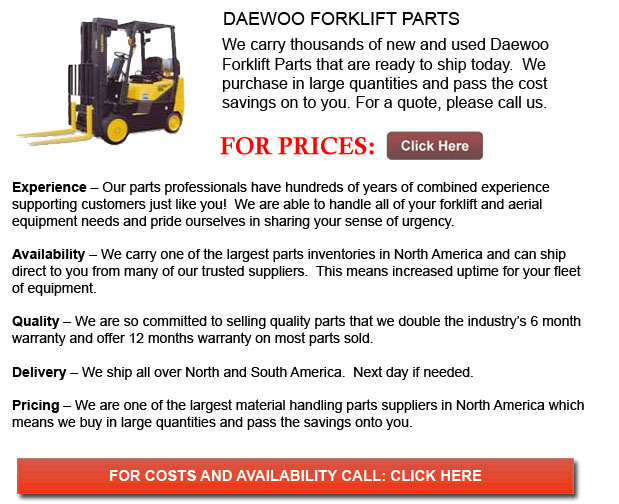

Daewoo Forklift Parts - During March of the year 1967, the Daewoo Group was established by Kim Woo-Jung. He was the son of Daegu's Provincial Governor. He first graduated from the Kyonggi High School and next went onto the Yonsei University in Seoul where he completed a Degree in Economics. Daewoo became one of the Big Four chaebol in South Korea. Growing into a multi-faceted service conglomerate and an industrial empire, the company was prominent in expanding its global market securing various joint ventures worldwide.
After the end of the Syngman Rhee government in the 1960s, Park Chung Hee's new government came aboard to encourage growth and development in the nation. This promoted exports, increased access to resources, financed industrialization, provided protection from competition to the chaebol in exchange for a company's political support. Initially, the Korean government instigated a series of 5 year plans under which the chaebol were required to accomplish a series of particular basic aims.
Once the second 5 year plan was applied, Daewoo became a major player. The company really profited from cheap loans sponsored by the government that were based on likely proceeds earned from exports. Initially, the business focused on labor intensive clothing industries and textile that provided high profit margins. South Korea's large workforce was the most significant resource in this particular plan.
Between the years of 1973 and 1981, when the third and fourth 5 year plans happened for Daewoo; Korea's labour force was in high demand. The countries competitive advantage began to dwindle because of increased competition from several countries. In response to this change, the government responded by concentrating its effort on electrical and mechanical engineering, construction efforts, petrochemicals, military initiatives and shipbuilding.
Eventually, Daewoo was forced by the government into shipbuilding. Although Kim was unwilling to enter the industry, Daewoo rapidly earned a reputation for producing competitively priced oil rigs and ships.
During the following decade, the government of Korea brought a lot more liberal economic policies by reducing positive discrimination, loosened the protectionist restrictions on imports, and encouraged private small businesses. While encouraging free market trade, they were likewise able to force the chaebol to be more aggressive overseas. Daewoo successfully started numerous joint ventures along with European and American companies. They expanded exports, semiconductor design and manufacturing, machine tools, aerospace interests, and various defense products under the S&T Daewoo Business.
Daewoo finally started producing affordable civilian helicopters and airplanes compared to counterparts in North America. Next the company expanded more of their efforts into the automotive trade. Remarkably, they became the 6th biggest automobile manufacturer on the globe. During this time, Daewoo was able to have great success with reversing faltering businesses within Korea.
Throughout the 80s and 90s, Daewoo moved into various sectors comprising consumer electronics, buildings, telecommunication products, computers and musical instruments like for example the Daewoo Piano.
Click to Download the PDF
Forklift Parts

TOLL FREE: 1-888-695-7994
Tampa, Florida
forkliftpartstampa.com
Email Us
About Us